
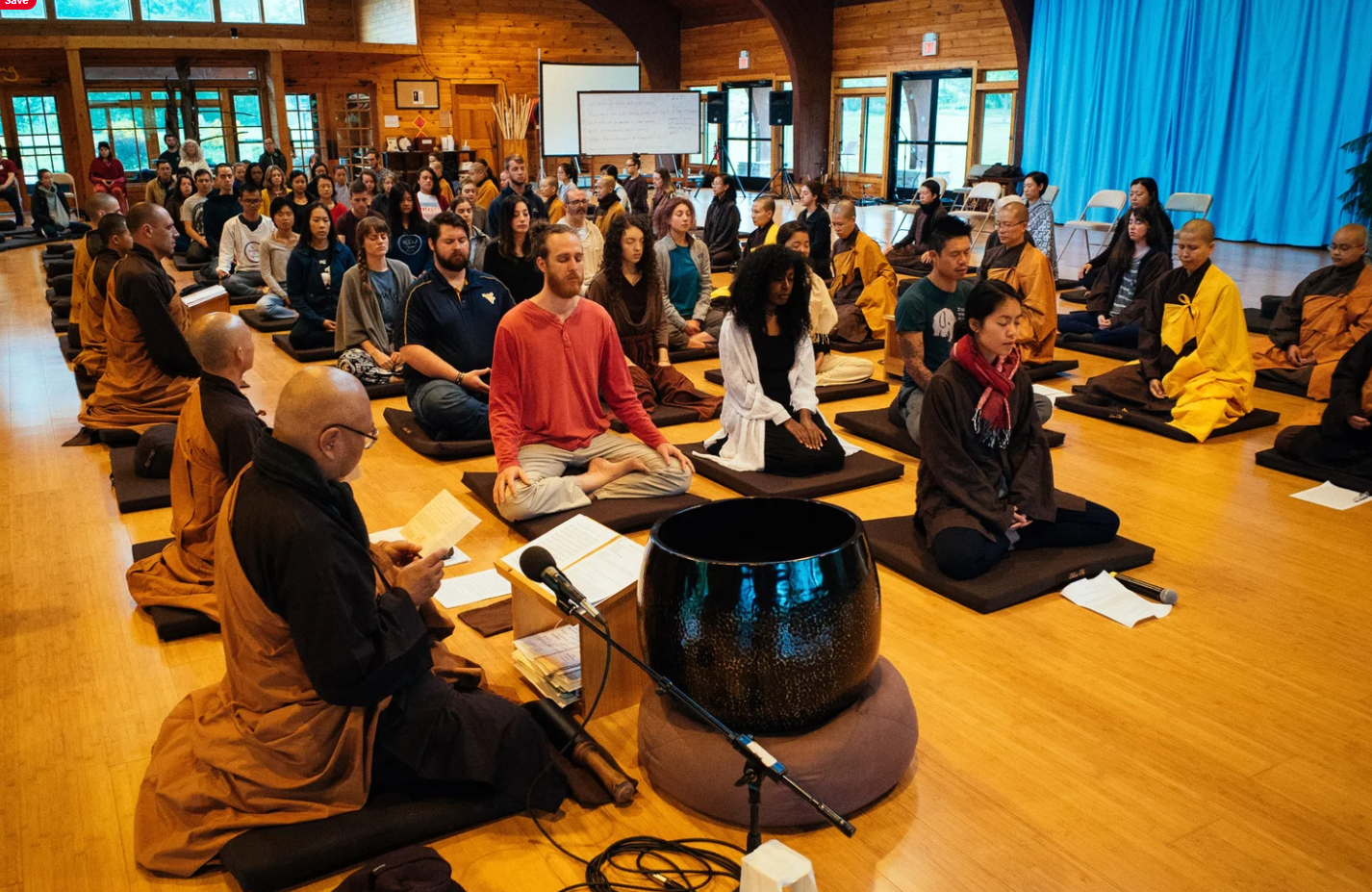
Resources for Sits and Community Gatherings
"It is possible the next Buddha will not take the form of an individual. The next Buddha may take the form of a community, a community practicing understanding and lovingkindness, a community practicing mindful living.”
-Thich Nhat Hanh
Listed here are commonly used texts, for both facilitators and participants in Kingfisher Sangha’s sits. These are the most up-to-date versions of these recitations.
-
The Five Mindfulness Trainings represent the Buddhist vision for a global spirituality and ethic. They are a concrete expression of the Buddha’s teachings on the Four Noble Truths and the Noble Eightfold Path, the path of right understanding and true love, leading to healing, transformation, and happiness for ourselves and for the world. To practice the Five Mindfulness Trainings is to cultivate the insight of interbeing, or Right View, which can remove all discrimination, intolerance, anger, fear, and despair. If we live according to the Five Mindfulness Trainings, we are already on the path of a bodhisattva. Knowing we are on that path, we are not lost in confusion about our life in the present or in fears about the future.
The First Mindfulness Training: Reverence for Life
Aware of the suffering caused by the destruction of life, I am committed to cultivating the insight of interbeing and compassion and learning ways to protect the lives of people, animals, plants, and minerals. I am determined not to kill, not to let others kill, and not to support any act of killing in the world, in my thinking, or in my way of life. Seeing that harmful actions arise from anger, fear, greed, and intolerance, which in turn come from dualistic and discriminative thinking, I will cultivate openness, non-discrimination, and non-attachment to views in order to transform violence, fanaticism, and dogmatism in myself and in the world.
The Second Mindfulness Training: True Happiness
Aware of the suffering caused by exploitation, social injustice, stealing, and oppression, I am committed to practicing generosity in my thinking, speaking, and acting. I am determined not to steal and not to possess anything that should belong to others; and I will share my time, energy, and material resources with those who are in need. I will practice looking deeply to see that the happiness and suffering of others are not separate from my own happiness and suffering; that true happiness is not possible without understanding and compassion; and that running after wealth, fame, power and sensual pleasures can bring much suffering and despair. I am aware that happiness depends on my mental attitude and not on external conditions, and that I can live happily in the present moment simply by remembering that I already have more than enough conditions to be happy. I am committed to practicing Right Livelihood so that I can help reduce the suffering of living beings on Earth and stop contributing to climate change.
The Third Mindfulness Training: True Love
Aware of the suffering caused by sexual misconduct, I am committed to cultivating responsibility and learning ways to protect the safety and integrity of individuals, couples, families, and society. Knowing that sexual desire is not love, and that sexual activity motivated by craving always harms myself as well as others, I am determined not to engage in sexual relations without mutual consent, true love, and a deep, long-term commitment. I resolve to find spiritual support for the integrity of my relationship from family members, friends, and sangha with whom there is support and trust. I will do everything in my power to protect children from sexual abuse and to prevent couples and families from being broken by sexual misconduct. Seeing that body and mind are interrelated, I am committed to learn appropriate ways to take care of my sexual energy and to cultivate the four basic elements of true love – loving kindness, compassion, joy, and inclusiveness – for the greater happiness of myself and others. Recognizing the diversity of human experience, I am committed not to discriminate against any form of gender identity or sexual orientation. Practicing true love, we know that we will continue beautifully into the future.
The Fourth Mindfulness Training: Loving Speech and Deep Listening
Aware of the suffering caused by unmindful speech and the inability to listen to others, I am committed to cultivating loving speech and compassionate listening in order to relieve suffering and to promote reconciliation and peace in myself and among other people, ethnic and religious groups, and nations. Knowing that words can create happiness or suffering, I am committed to speaking truthfully using words that inspire confidence, joy, and hope. When anger is manifesting in me, I am determined not to speak. I will practice mindful breathing and walking in order to recognize and to look deeply into my anger. I know that the roots of anger can be found in my wrong perceptions and lack of understanding of the suffering in myself and in the other person. I will speak and listen in a way that can help myself and the other person to transform suffering and see the way out of difficult situations. I am determined not to spread news that I do not know to be certain and not to utter words that can cause division or discord. I will practice Right Diligence to nourish my capacity for understanding, love, joy, and inclusiveness, and gradually transform anger, violence, and fear that lie deep in my consciousness.
The Fifth Mindfulness Training: Nourishment and Healing
Aware of the suffering caused by unmindful consumption, I am committed to cultivating good health, both physical and mental, for myself, my family, and my society by practicing mindful eating, drinking, and consuming. I will practice looking deeply into how I consume the Four Kinds of Nutriments, namely edible foods, sense impressions, volition, and consciousness. I am determined not to gamble, or to use alcohol, drugs, or any other products which contain toxins, such as certain websites, electronic games, TV programs, films, magazines, books, and conversations. I will practice coming back to the present moment to be in touch with the refreshing, healing and nourishing elements in me and around me, not letting regrets and sorrow drag me back into the past nor letting anxieties, fear, or craving pull me out of the present moment. I am determined not to try to cover up loneliness, anxiety, or other suffering by losing myself in consumption. I will contemplate interbeing and consume in a way that preserves peace, joy, and well-being in my body and consciousness, and in the collective body and consciousness of my family, my society and the Earth.
-
Invoking Avalokiteshvara
We invoke your name Avalokiteshvara. We aspire to learn your way of listening in order to help relieve the suffering in the world. You know how to listen in order to understand. We invoke your name in order to practice listening with all our attention and open-heartedness.
We will sit and listen without any prejudice. We will sit and listen without judging or reacting. We will sit and listen in order to understand. We will sit and listen so attentively that we will be able to hear what the other person is saying and also what is being left unsaid. We know that just by listening deeply we already alleviate a great deal of pain and suffering in the other person.
Short Form
Dear Friends,
Now is the time for Dharma Sharing. It is a time for all to practice loving speech and deep listening. Here are some important guidelines.
● Please indicate when you would like to talk and when you have finished. This may be done with a bow or some other gesture.
● There is no cross-talk, conversation, advice, or interruptions.
● Sharing topics focus on our practice, our life experiences, our struggles and successes.
● It is helpful to use the word “I” instead of “you,” and to speak from personal experience only.
● Be mindful of the time. Do not take so long that others are not able to share.
● If a Sangha sibling becomes upset, or simply talks too long, the bell may be invited by the facilitator. This is a gentle invitation to pause, breathe with one another, and return to our practice of mindfulness.
● Sharing is optional. Both silence and sharing can be a supportive part of the practice.
● Allow for pauses between offerings.
● Topics brought up by a sangha member during Dharma sharing should not be raised later. After a sit it is possible to gently offer support but please ask permission to do so.
● All sharing in Sangha is confidential.
-
Invoking Avalokiteshvara
We invoke your name Avalokiteshvara. We aspire to learn your way of listening in order to help relieve the suffering in the world. You know how to listen in order to understand. We invoke your name in order to practice listening with all our attention and open-heartedness.
We will sit and listen without any prejudice. We will sit and listen without judging or reacting. We will sit and listen in order to understand. We will sit and listen so attentively that we will be able to hear what the other person is saying and also what is being left unsaid. We know that just by listening deeply we already alleviate a great deal of pain and suffering in the other person.
Long Form (To be read at the discretion of the facilitator and/or when there are new participants)
Now we will prepare for Dharma Sharing. This is a time of deepening connections within our community and strengthening our practice. Please listen closely to these guidelines.
● Please indicate in some way comfortable for you, when you wish to begin and end talking. This may be done by bowing, placing a hand over your heart, or another gesture.
● This is a time of deep listening and loving speech for us all. These practices enrich not only our time together but our individual lives outside of Sangha.
● Please enjoy two or three breaths between sharings so our listening may be deep.
● Periods of silence are a fruitful part of Dharma Sharing.
● Discussion topics focus on our practice, our life experiences, our struggles and successes.
● It is helpful to use the word “I” instead of “you,” and to speak from personal experience only.
● A separate time is designated for announcements.
● There is no cross-talk, conversation, advice, or interruptions.
● Be sure not to speak too long or to take a second turn before everyone has had a chance to share.
● If a Sangha sibling becomes upset, or simply talks too long, the bell may be invited by the facilitator. This is a gentle invitation to pause, breathe with one another, and return to our practice of mindfulness.
● Topics brought up by a sangha member during Dharma sharing should not be raised later. After a sit it is possible to gently offer support but please ask permission to do so.
● For the safety of each sangha member, as well as the community at large, please remember that all sharings are confidential.
-
This food is a gift of the earth, the sky, numerous living beings, and much hard and loving work.
May we eat with mindfulness and gratitude so as to be worthy to receive this food.
May we recognize and transform unwholesome mental formations, especially our greed, and learn to eat with moderation.
May we keep our compassion alive by eating in such a way that reduces the suffering of living beings, stops contributing to climate change, and heals and preserves our precious planet.
We accept this food so that we may nurture our siblinghood, build our sangha, and nourish our ideal of serving all living beings.
-
Version 1:
We bow to the Buddha, and all our spiritual teachers.
We bow to the Dharma, and all that it teaches us.
We bow to the Sangha, our friends along the path.
May the fruits of our practice benefit all beings and the earth.
Version 2:We bow to the Buddha, the one who shows us the way in this life.
We bow to the Dharma, the way of understanding and love.
We bow to the Sangha, the community that practices in harmony and awareness.
May the fruits of our practice benefit all beings and the earth.
-
These chants can be used at the beginning of a sit by facilitators. They are optional ways to lead the community into the period of sitting meditation.
The Morning Chant:
The Morning Chant | Plum Village Website
The Morning Chant | Plum Village YouTube Channel
The Evening Chant:
The Evening Chant | Plum Village UK YouTube Channel
May the Day Be Well:
May The Day Be Well | Plum Village Website
The Great Bell Chant:The Great Bell Chant | Plum Village Website
The Great Bell Chant | Plum Village YouTube Channel
The Insight that Brings Us to the Other Shore (The Heart Sutra):
The Sutra of the Insight that Brings Us to the Other Shore (Heart Sutra) | Plum Village Website
Discourse on Love:
Discourse on Love | Plum Village Website
Namo Avalokiteshvaraya, Chant of Compassion:
Namo Avalokiteshvaraya - Chant of Compassion | Plum Village Website